Harris Kaplan
Postdoctoral fellow, Harvard University
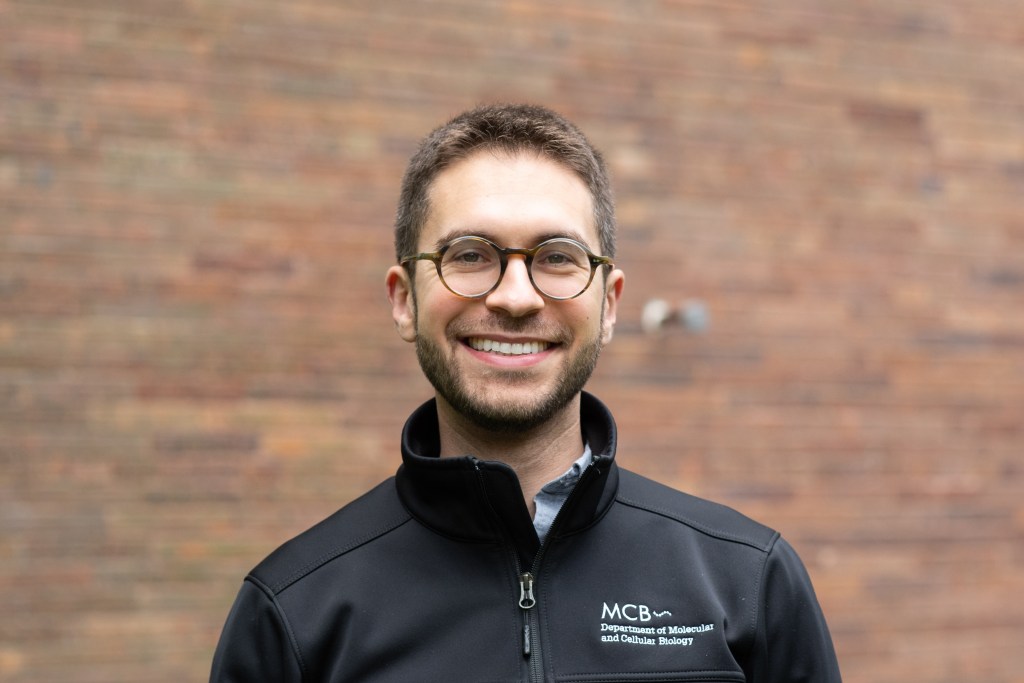
Hi! I’m Harris Kaplan.
I am currently a postdoctoral fellow in the Dulac lab at Harvard University. My work focuses on neuronal circuit function in developing animals.
Developing animals sense their environment, and behave in it, even in the womb. Neuronal circuits are active and functional well before they are mature, and such function has important implications for neurodevelopment. My goal is to uncover the molecular and circuit mechanisms by which neuronal circuit function emerges in early life and affects brain development.
I combine tools from systems neuroscience (e.g. neuronal activity recording and manipulation) and molecular biology (e.g. high-throughput sequencing).
In my PhD, I studied brain-wide neuronal population dynamics underlying behavior in C. elegans, in Manuel Zimmer’s lab at the IMP in Vienna, Austria.
Contact me at harris.kap@gmail.com.
CV | Google Scholar | Pubmed | Bluesky | Twitter
Research
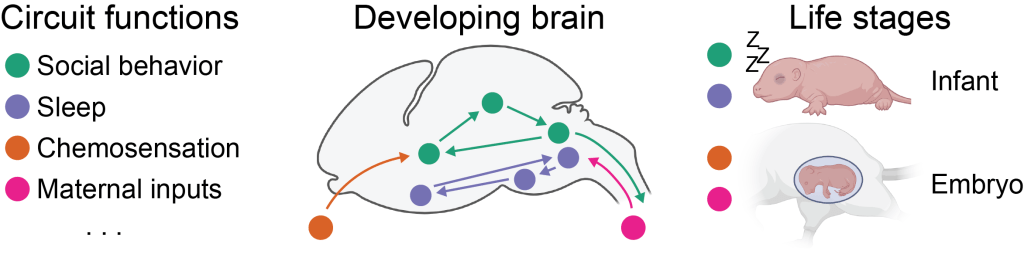
Developing animals behave differently from adults. This is partly due to immature circuits, but is also partly adaptive, because developing animals have unique needs and environments. How do developing circuits, while rapidly changing structure, drive coherent and age-appropriate functions? How do such functions feed back on the brain and affect brain development?
To start to address this, I established a molecular developmental atlas of the hypothalamic preoptic area (Kaplan et al., 2025). This brain region is essential for homeostatic control and social behavior in adults, but is not well studied developmentally. In this work, we described the developmental origins of ~150 neuronal cell types, including genetically defined cell types previously implicated in social behaviors, anxiety/stress, thirst, thermoregulation, sleep, and other functions. This work serves a foundation for future studies on circuit function and behavior in early life.
My future lab will unite systems neuroscience and molecular neurodevelopment to establish a mechanistic understanding of how neuronal circuit function impacts brain development.
Publications
Sensory input, sex, and function shape hypothalamic cell type development.
Nature, 2025. Access the paper here.
The neurobiology of parenting and infant-evoked aggression.
Harris S. Kaplan*, Patricia M. Horvath*, Mohammed Mostafizur Rahman*, & Catherine Dulac. *Equal contribution
Nested neuronal dynamics orchestrate a behavioral hierarchy across timescales.
Harris S. Kaplan*, Oriana Salazar Thula*, Niklas Khoss, & Manuel Zimmer. *Equal contribution
Brain-wide representations of ongoing behavior: a universal principle?
Harris S. Kaplan & Manuel Zimmer
Current Opinion in Neurobiology, 2020. Access the paper here.
For a complete list of publications, see Pubmed.
Contact
Contact me at harris.kap@gmail.com.
CV | Google Scholar | Pubmed | Bluesky | Twitter
 Harris Kaplan